
Placebo: One of the Most Powerful Tools in the Manual Therapist’s Toolkit
The word placebo has a branding problem.
In healthcare, calling something a placebo is often interpreted as saying the treatment is fake, the practitioner is somehow tricking the patient or—perhaps worst of all—that the patient’s improvement is “all in their head.”
But that’s not what modern placebo research tells us.
In fact, placebo research provides some fascinating insight into just how much expectation, previous experience, communication, conditioning and the therapeutic environment can influence the experience of pain.
For manual therapists, this matters enormously.
Because every treatment we provide occurs within a context.
The patient’s expectations, their previous experiences, their confidence in their practitioner, the explanation they receive, the environment in which treatment occurs and even the ritual surrounding treatment can potentially influence the clinical outcome.
Rather than pretending these influences don’t exist, perhaps we should be asking a different question:
How can we ethically use them to improve patient outcomes?

Placebo doesn’t mean “fake”
One of the biggest misconceptions about placebo is that if a patient improves because of a placebo effect, they somehow imagined the improvement.
That isn’t an accurate representation of what occurs.
Contemporary research describes placebo and nocebo effects as psychobiological responses produced through interactions between the person and the therapeutic context. Expectation, learning, conditioning and previous experience appear capable of influencing several neurophysiological systems involved in pain modulation.
For example, experimental research by Amanzio and Benedetti demonstrated that placebo analgesia generated through expectation can involve the body’s endogenous opioid system. When researchers administered naloxone—an opioid receptor antagonist—some placebo analgesic responses were reduced or eliminated.
Think about what that means.
A person is given something with no active analgesic ingredient.
They expect pain relief.
That expectation contributes to an analgesic response.
And pharmacologically blocking the body’s opioid receptors can reduce that response.
That is not imaginary pain relief.
There is genuine neurophysiology occurring.
Neuroimaging research adds further support. Meta-analyses of placebo analgesia studies have demonstrated changes in activity across multiple brain regions involved in pain processing, emotion, evaluation and cognitive regulation.
So perhaps saying:
“It’s just placebo”
doesn’t really do the phenomenon justice.

Placebo can be surprisingly powerful
One of the most extraordinary examples comes not from manual therapy—but surgery.
In a landmark study published in the New England Journal of Medicine, Moseley and colleagues recruited 180 people with knee osteoarthritis.
Participants were randomised to receive:
- arthroscopic debridement,
- arthroscopic lavage, or
- placebo surgery.
The placebo group underwent the theatre experience and received skin incisions, but the actual arthroscopic procedure was simulated.
The result?
The researchers found that the two arthroscopic procedures were no better than placebo surgery for pain and self-reported function during follow-up.
That’s remarkable.
It does not mean surgery in general is placebo.
It doesn’t mean tissue pathology doesn’t matter.
And it certainly doesn’t mean we should start pretending to perform procedures.
What it beautifully demonstrates is that:
Improvement after an intervention does not automatically prove that the proposed mechanism of that intervention caused the improvement.
That idea should be enormously important to manual therapists.
If we mobilise a joint and the patient immediately reports:
“Wow—that’s 80% better!”
that improvement is completely real.
But it doesn’t necessarily prove that we:
- repositioned a vertebra;
- broke down an adhesion;
- released fascia;
- corrected a pelvic rotation; or
- mechanically “put something back in place.” (and yes, all these reasons are ridiculous and outdated concepts )
Something happened.
But determining what happened is a very different scientific question.


Manual therapy is perfectly positioned to harness contextual effects
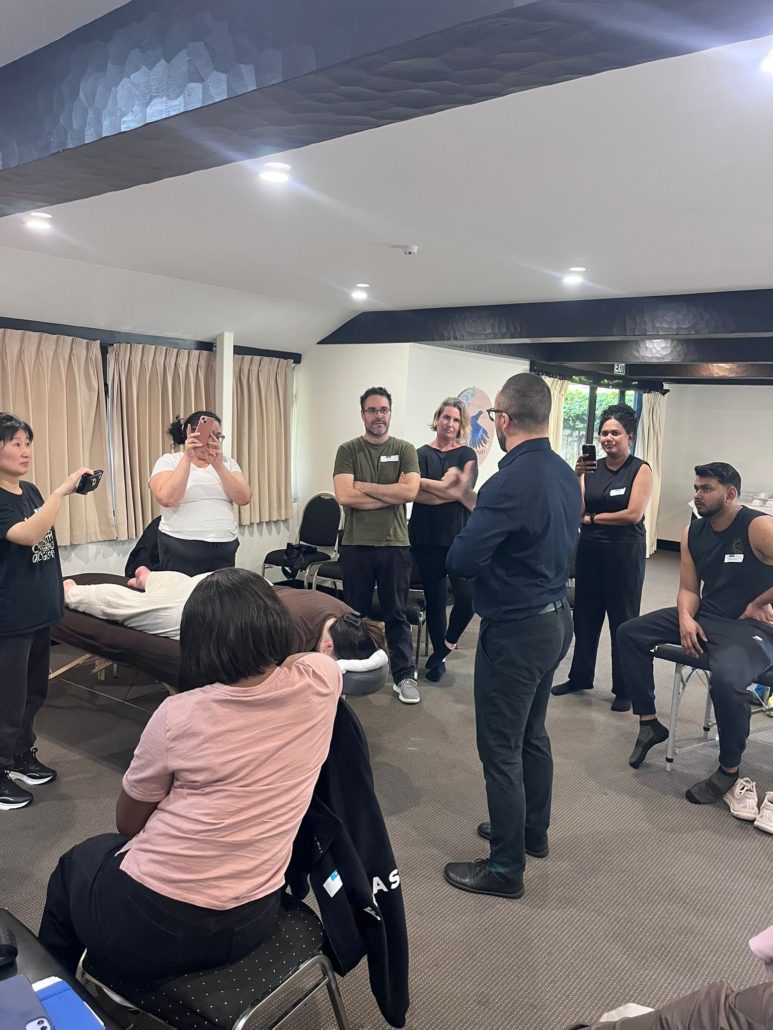
Consider what happens during a typical manual therapy consultation.
A patient arrives concerned about their pain.
We listen to their story.
We examine them.
We touch the painful area.
We explain what we think is happening.
We provide treatment.
We reassess them.
Hopefully, they feel better.
There are potentially multiple therapeutic inputs occurring simultaneously.
There may be physiological responses associated with the manual intervention itself.
But there are also effects associated with:
touch.
expectation.
reassurance.
attention.
previous experience.
therapeutic alliance.
conditioning.
the credibility of the practitioner.
the patient’s interpretation of what is happening.
Bialosky and colleagues specifically explored this issue in relation to manual therapy, arguing that placebo responses likely contribute to interventions for pain and should be considered among the mechanisms that may contribute to outcomes following manual therapy.
Their broader model of manual therapy mechanisms similarly proposes that manual therapy shouldn’t simply be understood as a mechanical force changing tissue. Instead, the intervention potentially produces a cascade of neurophysiological responses involving the peripheral nervous system, spinal cord and supraspinal mechanisms.
That doesn’t diminish manual therapy.
It makes manual therapy considerably more interesting.

You don’t necessarily have to deceive someone to produce a placebo effect
Perhaps one of the most fascinating developments in placebo research has been the study of open-label placebos.
These are placebos given to people who are explicitly told:
“This is a placebo.”
No deception.
No secret active ingredient.
In an influential study by Kaptchuk and colleagues, patients with irritable bowel syndrome were randomised to either no treatment or openly prescribed placebo pills.
After three weeks, the open-label placebo group reported significantly greater global improvement and reductions in symptom severity than the no-treatment group.
Since then, the evidence base has grown.
A 2021 systematic review and meta-analysis evaluated clinical trials of open-label placebo across conditions including back pain, cancer-related fatigue, IBS, allergic rhinitis, depression and menopausal symptoms. The review found an overall benefit compared with no treatment, although the authors also highlighted methodological limitations and moderate risk of bias within the existing evidence.
An updated systematic review published in 2025 included 60 randomised controlled trials and found small overall beneficial effects of open-label placebo, with effects generally more apparent for subjective outcomes than objective physiological measures.
And particularly relevant to us, a 2025 systematic review specifically examining chronic musculoskeletal pain found that open-label placebo produced small-to-moderate improvements in patient-reported pain, while improvements weren’t demonstrated to the same extent in objective physical-function testing.
There’s an important message here.
Placebo isn’t magic.
It isn’t regenerating cartilage.
It isn’t reconnecting a ruptured tendon.
And it isn’t repositioning vertebrae through the mysterious power of positive thinking.
But when we’re talking about something like pain—which is itself a perceptual experience—context and expectation can matter enormously.
So, let’s not hide from the effects of placebo. Instead, we can intentionally utilise placebo through our language, the clinical setting, the procedures we follow that demonstrate competence, and the trust and rapport we build with our patients, to further enhance the therapeutic outcomes that our treatments provide.
It’s time Placebo had a rebrand! 😊
