
The Whole Picture: Why Pathophysiology Matters in clinical practice
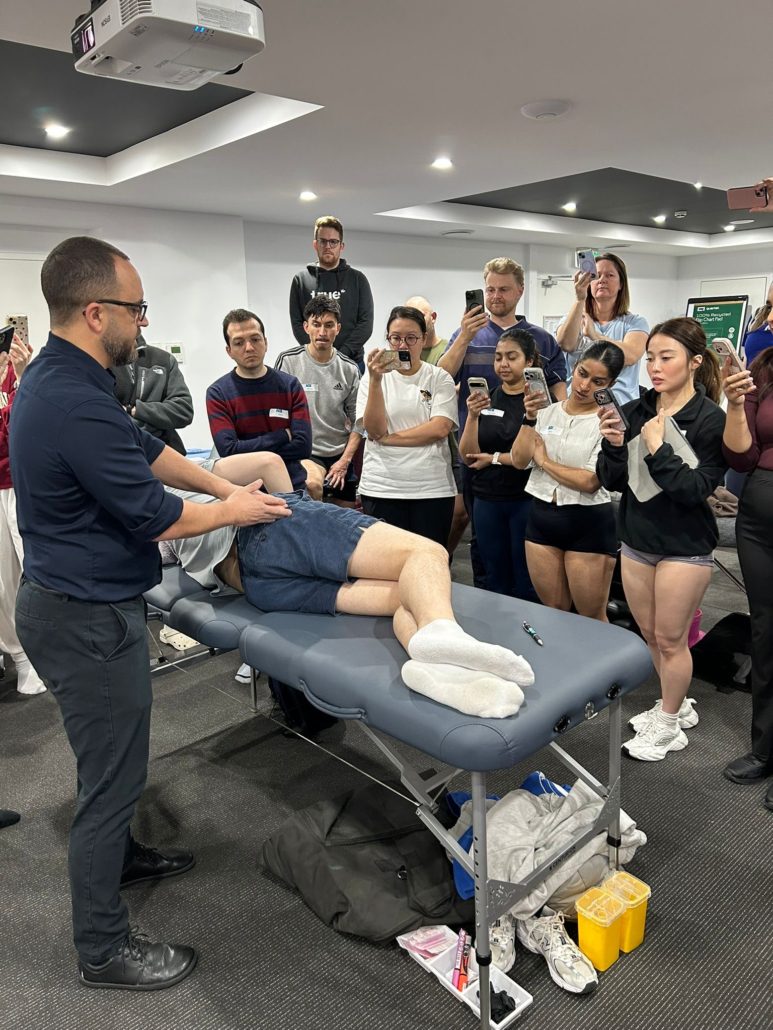
A patient walks into your clinic with anterior knee pain.
Their quads are weak. Squatting hurts. Stairs are a problem.
Easy.
Strengthen the quads.
Except… why are the quads weak?
That question matters more than we sometimes realise.
Because weakness isn’t always simply a lack of strength. Sometimes the nervous system is actively limiting how much force a muscle can produce.
And if we don’t understand why something is happening, there’s a risk we end up treating the symptom rather than the problem.
Patellofemoral pain (PFP) is a brilliant example.
Weak quads aren’t always just weak quads
Reduced quadriceps strength is commonly associated with PFP, and strengthening absolutely has a role in rehabilitation.
But finding weakness should be the beginning of our reasoning—not the end of it.
One potential contributor is arthrogenic muscle inhibition (AMI).
AMI is essentially a neurological reduction in our ability to fully activate a muscle due to altered sensory information coming from a joint.
In simple terms, the muscle may be capable of producing more force, but the nervous system isn’t giving it full access to the accelerator.
And something as simple as fluid in the knee can contribute to this.
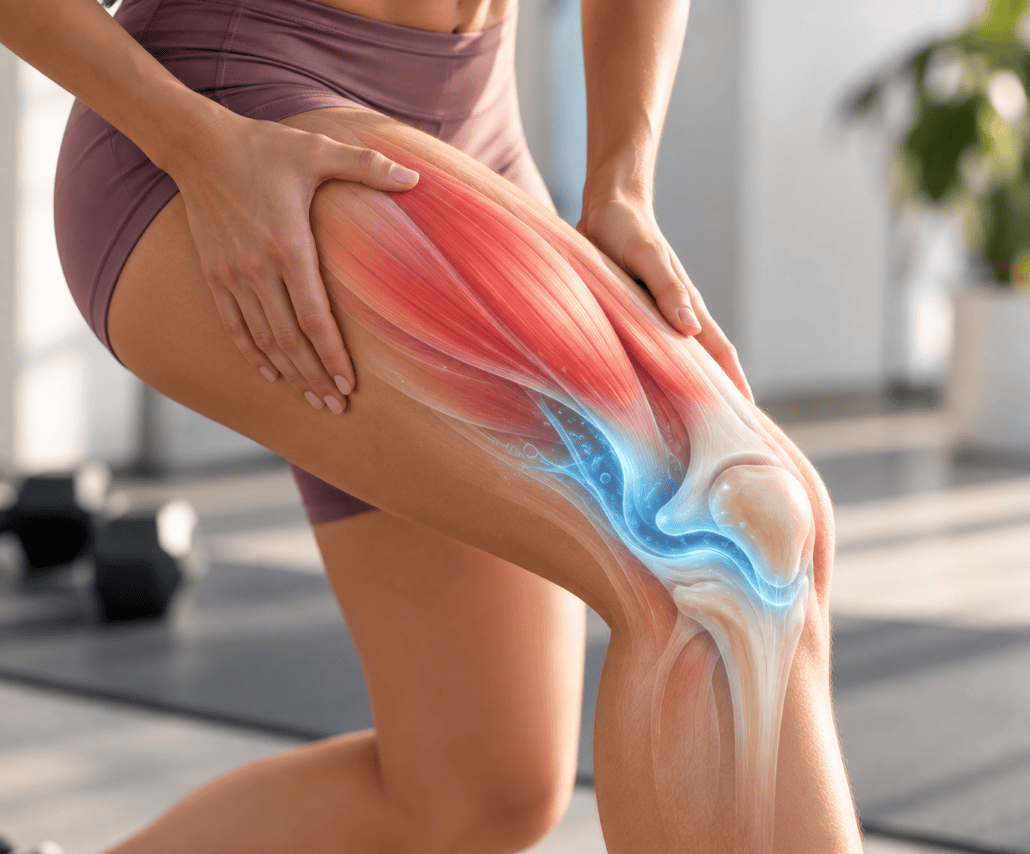
Fluid can change the way the quadriceps work
When a knee becomes irritated, an increase in intra-articular fluid can occur.
We often think of swelling as merely a consequence of injury or irritation.
But that fluid can actually change motor output.
Palmieri-Smith and colleagues experimentally introduced fluid into healthy knees and found reduced activation of both vastus medialis and vastus lateralis. As effusion increased, participants also changed the way they loaded their knees. (pubmed.ncbi.nlm.nih.gov)
Other experimental research has demonstrated reduced quadriceps EMG activity during jogging following knee joint effusion. (pmc.ncbi.nlm.nih.gov)
Perhaps even more interestingly, research examining intra-articular pressure found that quadriceps strength progressively decreased as joint effusion increased—and improved again after the fluid was aspirated. (pubmed.ncbi.nlm.nih.gov)
Think about what that means in the clinic.
You test the quads.
They’re weak.
So, you prescribe strengthening.
But what if part of that weakness is occurring because the irritated knee is changing sensory input to the nervous system, which is then changing motor output back to the quadriceps?
Suddenly, “weak quads” isn’t the diagnosis. It’s a clue.
Pain can do it too.
Here’s where things get even more interesting.
We don’t necessarily need significant swelling to see inhibition.
Pain itself can reduce quadriceps function.
Experimental research examining pain and joint effusion independently has demonstrated that both can reduce quadriceps activation and strength. (pubmed.ncbi.nlm.nih.gov)
This has also been demonstrated in people with patellofemoral pain. When researchers compared painful and relatively pain-free conditions, acute pain was associated with greater arthrogenic muscle inhibition and reduced activation of the knee musculature during running. (pubmed.ncbi.nlm.nih.gov)
Now we have a much more interesting picture…
Knee irritation creates pain and perhaps some effusion.
Pain and effusion alter sensory input.
Motor output to the quadriceps changes.
Quadriceps function drops.
The person’s ability to manage load may change.
And potentially, the knee becomes irritated again.
It’s unlikely to be a perfectly linear cycle, because biology rarely is.
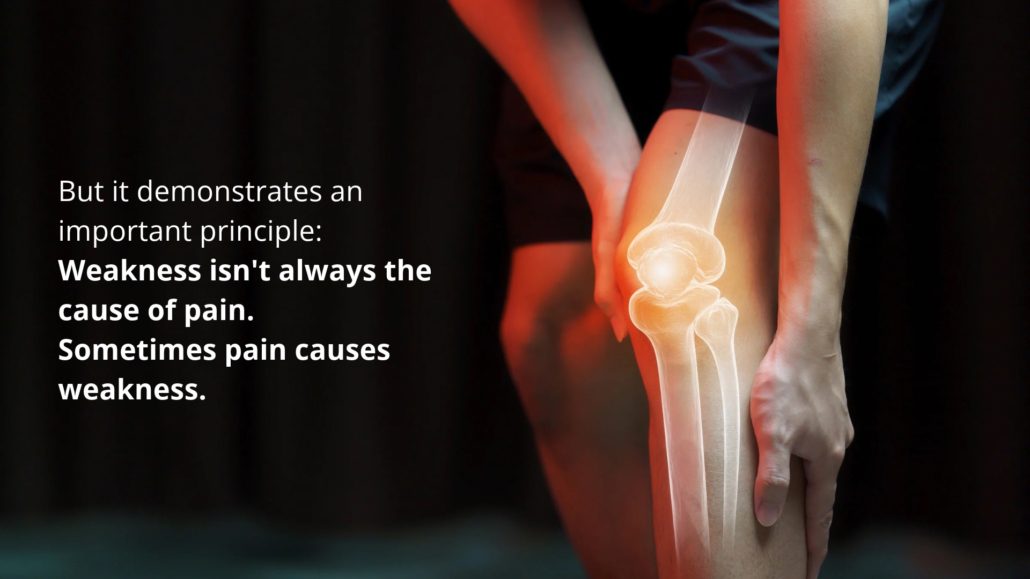
And sometimes both are happening at once.
And what about the popliteus?
This is where looking beyond the obvious becomes important.
The popliteus is a small muscle buried deep behind the knee. Compared with the quads, hamstrings and glutes, it doesn’t get much attention.
But it’s an interesting little muscle.
It contributes to rotational control of the tibiofemoral joint, assists in initiating knee flexion and contributes to posterolateral stability. (pubmed.ncbi.nlm.nih.gov)
The popliteus can also become a source of pain itself, particularly during running and activities involving rotational loading. (pubmed.ncbi.nlm.nih.gov)
So, imagine someone whose knee hurts and whose quadriceps output has dropped.
Their loading strategy changes. Their movement changes. Their rotational control may change.
Is it possible other structures start working harder?
Of course.
Could the popliteus be one of them?
Potentially.
But this is where good clinicians need to resist the temptation to turn a plausible theory into a fact.
There isn’t strong evidence demonstrating a neat pathway where an “overactive popliteus” directly inhibits the quadriceps and therefore causes patellofemoral pain.
That doesn’t mean we ignore it.
It means we understand its anatomy, consider its potential contribution and assess whether it’s relevant to the person standing in front of us.
That’s evidence-informed practice—not simply repeating a mechanism because it sounds good.
Same symptom. Different story.
Imagine two patients walk into your clinic.
Both have patellofemoral pain.
Both have weak quadriceps.
One has reduced quadriceps capacity following a rapid increase in running volume.
The other has an irritated, painful knee with mild effusion contributing to significant quadriceps inhibition.
Same finding.
Different pathophysiology.
And potentially a different treatment emphasis.
That’s why understanding pathology doesn’t make us less holistic.
It makes us more holistic.
Instead of asking:
“Which muscle is weak?”
Ask:
“Why is it weak?”
Instead of:
“Where does it hurt?”
Ask:
“Why might it hurt?”
And instead of immediately trying to correct someone’s movement, ask:
“Why did their movement change in the first place?”
Maybe they’re protecting a painful joint.
Maybe effusion is changing muscle activation.
Maybe reduced quadriceps output has altered loading.
Maybe other muscles are compensating.
Maybe their training load simply exceeded their current capacity.
Or, more realistically, maybe several of those things are happening together.
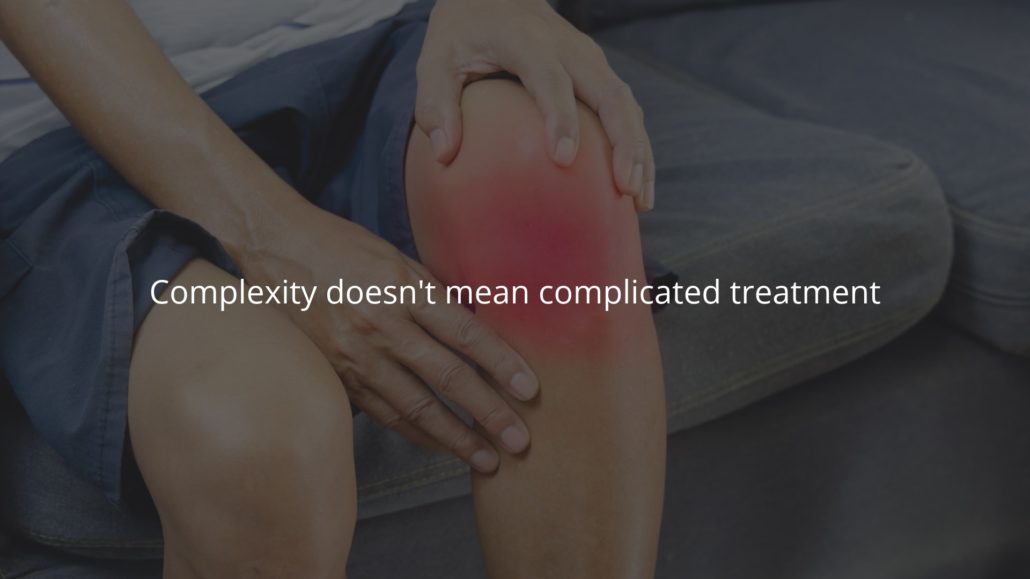
Understanding all of this doesn’t mean throwing twelve different treatments at the patient.
Quite often, better understanding makes treatment simpler.
Perhaps modifying load settles the irritated knee.
Perhaps reducing pain allows better quadriceps activation.
Perhaps manual therapy creates a short-term window in which movement and exercise become easier.
Perhaps progressive strengthening restores capacity.
Perhaps hip, ankle or tibiofemoral mechanics deserve attention.
Or perhaps the most valuable thing we can do is explain to someone that their weak quadriceps doesn’t necessarily mean the muscle is damaged or their knee is failing.
Treatment can be simple.
The thinking behind it shouldn’t be.
The human body rarely gives us neat, one-variable problems.
Pain influences movement.
Inflammation influences neural activity.
Sensory input influences motor output.
Motor output changes loading.
Loading influences tissue.
And tissue feeds information straight back into the nervous system.
Everything talks to everything else.
The more we understand these relationships, the less tempted we become to reduce someone’s pain to a tight muscle, a weak muscle, a “bad” movement pattern or a structure that simply needs releasing.
Pathophysiology gives us context.
It gives us better questions.
And better questions lead to better clinical reasoning.
Great therapy isn’t about memorising a treatment for every condition.
It’s about having the curiosity to keep asking:
What’s actually happening here—and why?
Because once we understand the whole picture, we stop simply chasing symptoms.
And we start treating the person in front of us.
