
What is in your manual therapy cocktail?

As we each progress through our individual careers in manual therapy, we tend to accumulate various skills, tools and approaches.
Our professional development is often built on the idea that we need to learn new things and “stack” modalities into our toolkit.
What I’ve often seen happen is practitioners ultimately feeling the need to utilise as many of their acquired skills into each session. Perhaps in an attempt to justify their service, perhaps to demonstrate their advanced abilities, or may just because they want to GIVE more.

Whatever the reason, it is important to remember that more does not equal better. Better equals better.
What does this mean…?
The human body is one big collection of sensory receptors. We have countless structures that are designed to receive all manner of information from our environment, both externally and internally. When we apply manual therapy, we are providing information for the patient’s body to receive, process and respond to. This is the crux of what we do clinically. We provide input, so the body can respond in a positive and meaningful way. What happens then if we do TOO MUCH in a session with a patient? In some cases, it can lead to input that exceeds what is optimal, which then results in an exaggerated response, or one that even moves in the opposite direction from the intended.
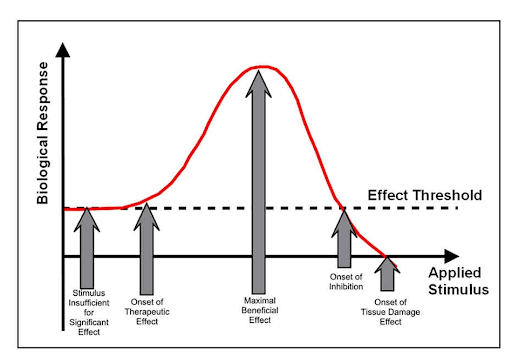
The Arndt Shultz Law perfectly captures this.
The concept of Temporal Summation is key here.
Temporal Summation describes the concept of several inputs all arriving close together, leading to a larger response than any one input could produce on its own. Think of pushing a child on a swing. One push and they get moving a little, several more pushes of the same effort, all delivered close together, and soon child is swinging high. It is not about the input, it is about the accumulated effect of several inputs.
Our nervous systems operate on thresholds. For patients in pain, their threshold of activation is generally very low. A small input may be enough to trigger a positive response. Several inputs together summate and produce larger action potentials, sometimes leading to more pain, and even lower thresholds.
Consider each manual therapy technique you use.
What is my goal with this patient today?
To what degree does this provide excitatory input?
o what degree does this proved inhibitory input?
Do I understand the nuance in the mechanisms of effect that are produced by this manual therapy technique?
These questions are key in helping you understand:
1. If this the right technique to use on this patient, right now.
2. What will happen if I combine this input with other techniques.
2. What dosage I should be applying, with regard to this technique, for this patient.
Our responsibility at health care providers is to not just possess the skills and knowledge to be able to help people in need, but also to know when, when not, how much and how little we should apply them.
Treatment planning need not be a game of filling a session with as much activity as possible.
Instead, it would be best to focus our efforts on deeply understanding what your patient needs in that moment, and distilling down what you are capable of to the most targeted and most outcome focussed intervention, for them.
